Naver Pay vs Kakao Pay for Foreigners: Which to Use in 2026
On this page
- Naver Pay vs Kakao Pay for Foreigners: What Actually Differs
- Can You Use Kakao Pay Without a Korean Bank Account?
- Can Foreigners Open a KakaoBank Account?
- Does Naver Pay Accept Foreign Credit Cards?
- Korean Payment Apps for Tourists: Which One to Set Up
- What Changes Once You Have an ARC?
- Frequently Asked Questions
Two apps handle the overwhelming majority of mobile payments in Korea, Naver Pay and Kakao Pay, yet as of 2026 only one of them will let a visitor without a Korean bank account actually pay for anything. The gap comes down to a single gatekeeper: identity verification. Kakao Pay was built around a Korean bank account and a locally verified phone number, which in practice means holding an Alien Registration Card (ARC). Naver Pay went the other way. It began accepting foreign-issued credit cards in May 2025, and in June 2026 it started letting foreigners verify themselves with a passport instead of a Korean mobile number. For a short-term visitor that difference decides which app is real and which is a wall.
Quick answers
- Naver Pay is the app a tourist can actually set up: it has accepted foreign-issued credit cards since May 2025, no ARC or Korean bank account required to register one.
- Since 4 June 2026 Naver has also accepted a passport issued outside Korea as identity verification, which removes the Korean-phone-number step that used to strand short-stay visitors.
- Kakao Pay remains, in practice, a residents-only wallet, because registration ties your account to a Korean bank and a locally verified Korean phone number.
- KakaoBank is a different product from Kakao Pay. Its everyday accounts are still built for Korean residents, and the bank has said foreigner-specific accounts are planned for the fourth quarter of 2026.
- The ARC that unlocks all of this is only issued to people staying more than 90 days, which is why the resident-versus-visitor split decides everything here.
- Neither app replaces a T-money card for buses and subways, so a visitor’s realistic setup is Naver Pay for shops plus a physical transit card.
Naver Pay vs Kakao Pay for Foreigners: What Actually Differs
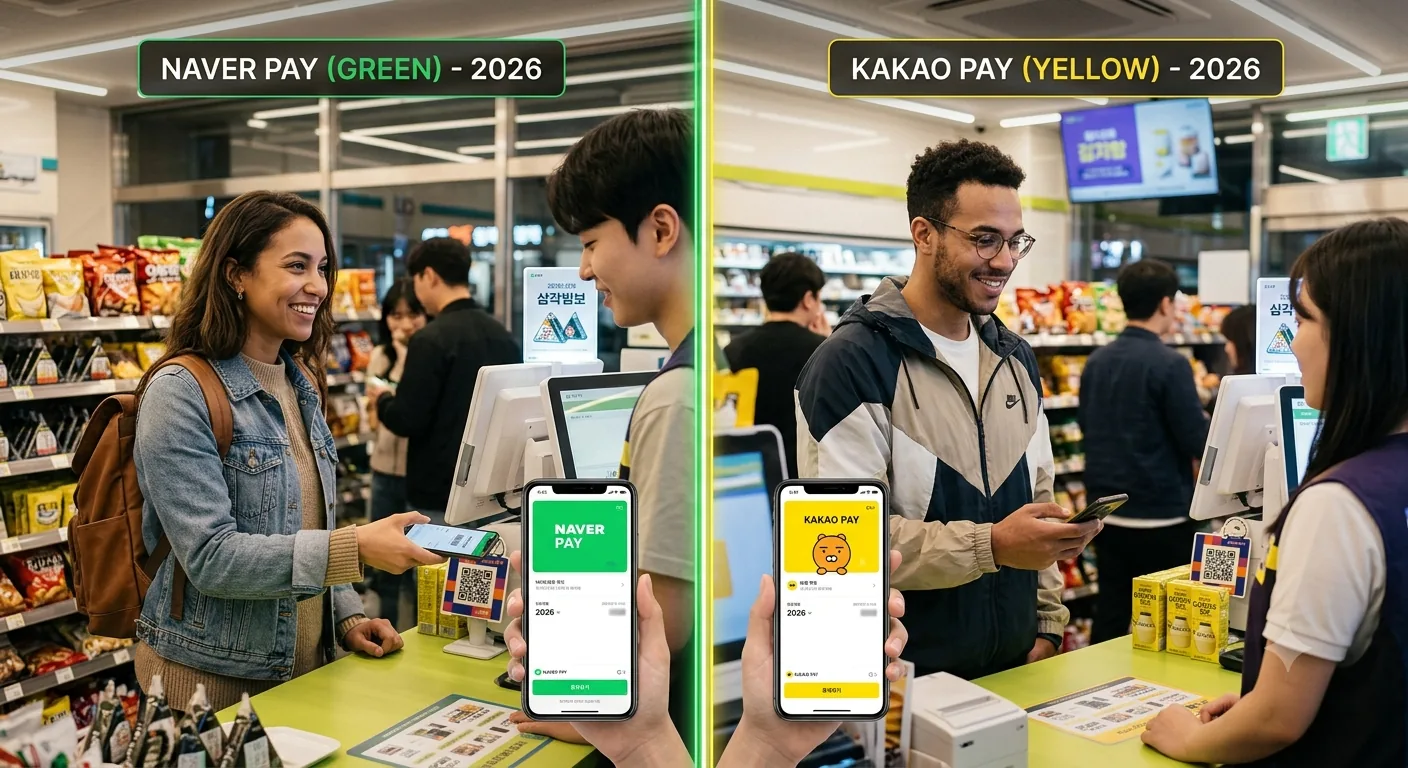
The core difference is identity verification, not features: Naver Pay can be registered by a tourist with a foreign card, while Kakao Pay stays locked behind Korean residency. Both apps do the same everyday jobs — QR payments at convenience stores, online checkout, and money transfers — and Koreans treat them as interchangeable. The moment a foreigner tries to sign up, though, they stop being equivalent.
| Naver Pay | Kakao Pay | |
|---|---|---|
| Foreign credit card | Accepted since May 2025 | Not accepted |
| Passport as ID verification | Accepted since June 2026 | Not offered |
| ARC required | No | Yes, in practice |
| Korean bank account | Not required | Required |
| Realistic for a tourist | Yes | No |
What surprises most first-time visitors is that the wallet everyone around them is tapping (Kakao Pay, riding on the KakaoTalk messenger nearly every Korean uses) is usually the one they cannot open.
Can You Use Kakao Pay Without a Korean Bank Account?
Not in any practical sense: Kakao Pay’s registration links your wallet to a Korean bank account and a Korean-carrier phone number, and both of those effectively require an ARC. The app leans on Korea’s identity-verification system, which checks your name against a registered Korean phone number issued under your foreign resident ID. Without residency you cannot get that phone number, and without the phone number you cannot clear verification, so the Kakao Pay ARC requirement is real even though Kakao never advertises it as a hard rule. Some travelers try loading a Korean prepaid SIM to get around it, but the verification still expects an underlying registered identity, and most report hitting the same wall. The card at the bottom of that chain is not something a tourist can apply for either: foreign residents register for an ARC precisely because they are staying beyond 90 days, so the requirement quietly encodes “live here first”.
Can Foreigners Open a KakaoBank Account?
Not through the ordinary sign-up, and it is worth separating this question from Kakao Pay. KakaoBank is a licensed internet-only bank; Kakao Pay is a wallet that sits on top of a bank account somebody already has. The shared brand hides two different onboarding systems, which is why a search about one keeps returning answers about the other. KakaoBank’s account opening runs on Korean resident identity verification, so a foreign resident has generally had to open an account the older way, in a branch, with a passport and an ARC.
That branch route did get lighter. The Financial Services Commission announced that from 21 March 2025 registered foreigners could open bank accounts using a mobile alien registration card, issued through the Mobile ID app to anyone aged 14 or over who holds a physical ARC. Six banks joined that first wave, and all six are conventional banks. No internet-only bank was among them, which is a fair summary of where foreigners stand with Korea’s app-first banks generally.
KakaoBank has said this is changing. The bank told investors on an earnings call that it intends to launch accounts built specifically for foreign residents in the fourth quarter of 2026, and it is separating its product terms ahead of that launch so the existing deposit accounts and the planned foreigner accounts sit under different rules. Until those accounts actually appear, treat any answer about KakaoBank and foreigners as perishable, and check the app rather than a blog post.
Does Naver Pay Accept Foreign Credit Cards?
Yes, and the date matters. Korean business daily Asia Economy reported on 15 May 2025 that Naver Pay would begin supporting foreign-issued credit cards as a registered payment method, with rollout expected around 29 May 2025. That single change is what makes the app usable on a tourist visa, and it happened a good deal earlier than most English write-ups suggest.
The same report carried a caveat that rarely survives translation: Naver acknowledged that the identity-verification step required when registering a payment method is difficult for short-stay foreigners, and said it was reviewing ways to improve it. So treat “foreign cards accepted” as true at the policy level while expecting friction at the individual-card level, because which cards clear verification varies by issuer and by when you try. You register through the Naver app, add the card the way you would in any Western wallet, and pay by QR or online checkout. The Naver Pay foreign credit card path is not flawless: a handful of smaller domestic merchants still only accept Korean-issued cards, and some in-app services built for residents remain closed. For paying at franchises, cafes, and major online stores, though, it works, and it is the closest thing Korea has to an Apple Pay-style drop-in for outsiders.
That verification friction has since eased, which is the part most guides have not caught up with. Naver introduced passport verification on 4 June 2026, letting a visitor holding a passport issued outside Korea confirm their identity inside the app rather than through a Korean mobile number or a support ticket. Naver’s announcement puts booking, ordering and payment flows behind that method, Naver Pay included, and says the list of supported services will widen in stages. So if a guide tells you a Korean phone number is mandatory before you can pay through Naver, it was written before that change and you should test the passport route first.
Korean Payment Apps for Tourists: Which One to Set Up
For a visitor, the answer is short: install Naver Pay, skip Kakao Pay, and carry a transit card. Korean payment apps for tourists tend to get recommended in bulk by old blog posts, but the ARC gate means most of those lists were written for residents. Naver Pay covers your retail and online spending, and a physical T-money card covers the transit system that neither wallet fully handles. If you want the refund mechanics for leftover balance, see our guide to T-money card refunds at the airport. Regulars will tell you to set up Naver Pay on hotel wifi the night you arrive, because verifying a foreign card occasionally needs a retry.
What Changes Once You Have an ARC?
Everything opens up: with an ARC and a Korean bank account, both Naver Pay and Kakao Pay become fully available, and most residents settle on Kakao Pay as their default. That is because Kakao Pay is stitched into KakaoTalk, so splitting a bill or sending money to a friend happens inside the same chat app you already use all day. Naver Pay stays strong for shopping, especially anything bought through Naver’s own commerce and reservation ecosystem. So the resident’s choice is a matter of habit and rewards, whereas the visitor’s choice is simply about which app will let them in at all.
Reaching that point is a visa question rather than a payments question, and the answer decides your wallet for you. If you are weighing a longer stay, our guide to the F-1-D workation visa requirements covers the route most remote workers ask about, and it is the ARC at the end of it, not the app store, that opens Kakao Pay.
Frequently Asked Questions
Q: Can I use Naver Pay in Korea as a tourist?
Yes. Naver Pay has accepted foreign-issued credit cards registered directly in the app since May 2025, so you can pay by QR and online checkout without an ARC or a Korean bank account. One caveat still applies: a few smaller local merchants take Korean cards only.
Q: Can I pay in Korea without a Korean phone number?
Through Naver, yes, and this is the newest thing on this page. Naver’s passport verification, live since 4 June 2026, was built for exactly this situation, letting someone with an overseas passport clear identity checks in the app and then book, order and pay. Kakao Pay has no equivalent, so its sign-up still dead-ends without a Korean-carrier number.
Q: When exactly did Naver Pay start accepting foreign cards?
May 2025. Asia Economy reported the policy on 15 May 2025 with rollout expected from around 29 May. If a guide tells you the change happened in late 2025 or later, it’s working from a stale note.
Q: Why can’t I sign up for Kakao Pay as a foreigner?
Kakao Pay’s identity verification requires a Korean bank account and a phone number registered under a Korean resident ID, which means you need an ARC. Short-term visitors cannot clear that verification, so the wallet stays effectively residents-only. A foreign resident who already has the ARC, the Korean number and the bank account signs up normally, selecting the foreigner option and entering the registration number from the card.
Q: Is KakaoBank the same thing as Kakao Pay?
No, and mixing them up is the most common mistake in this whole topic. KakaoBank is a bank that holds your money; Kakao Pay is a wallet that spends money held elsewhere. They share a brand and almost nothing else, including their rules on who may register, so an answer about one tells you nothing reliable about the other.
Q: Do I still need a T-money card if I have Naver Pay?
Generally yes. Neither Naver Pay nor Kakao Pay replaces the tap-in transit card that buses and subways expect, so most visitors carry a physical T-money card for transport and use Naver Pay for shops and online purchases.
Q: Is Kakao Pay or Naver Pay more popular in Korea?
Among residents Kakao Pay is often the daily default because it lives inside KakaoTalk, while Naver Pay dominates shopping tied to Naver’s commerce ecosystem. For foreigners the popularity contest is moot, since only Naver Pay is realistically available without residency as of 2026.
The rule of thumb is simple: until you hold an ARC, Naver Pay is your Korean wallet, and Kakao Pay is the one waiting for you the day you become a resident.
The Naver Pay card policy and its verification caveat come from Asia Economy’s 15 May 2025 report; the passport-verification launch comes from Naver’s own announcement of 9 June 2026; the mobile alien registration card rules come from the Financial Services Commission’s release of 20 March 2025. KakaoBank’s plan for foreigner accounts is the company’s own statement to investors, not a shipped product. All of it was rechecked on 2026-09-09. Payment and banking rules for foreigners change quietly and often, so confirm in the app before you rely on it.
Part of IT Platforms & Digital Economy